











WASHINGTON D.C.
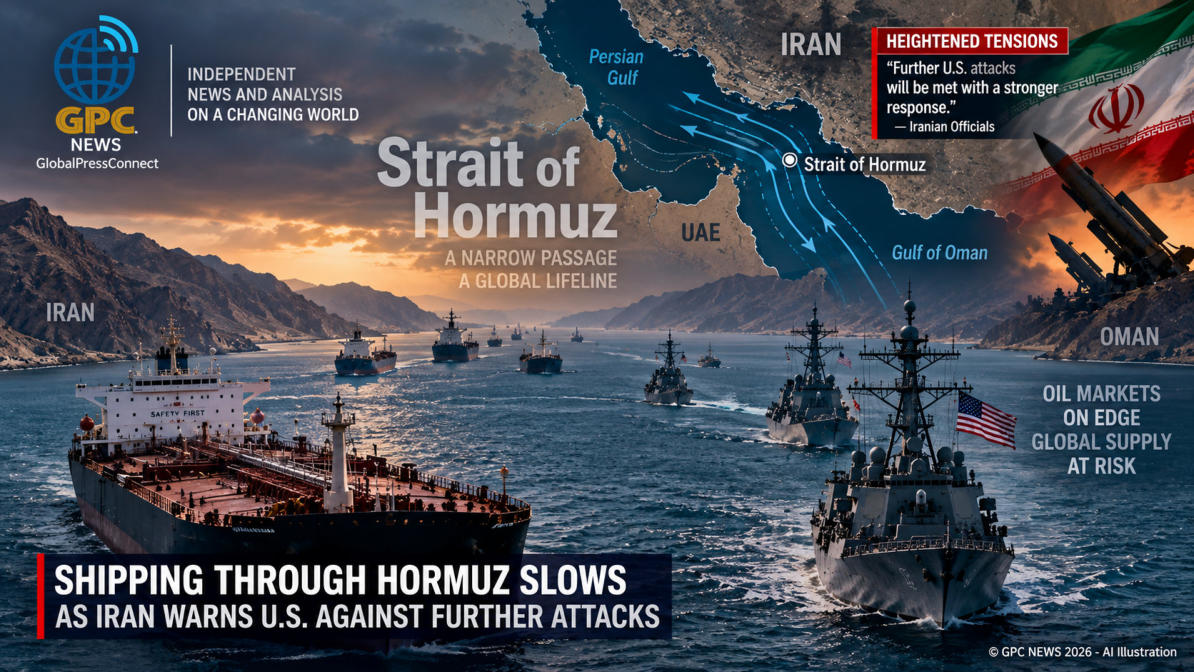
Global Press Connect provides independent news and analysis on international  politics, the economy, and humanitarian developments. © 2026 GlobalPressConnect | GPC.NEWS Founded and operated by Simone Mayer & Helping Hands for Children Foundation Inc. | Los Angeles, California, USA GlobalPressConnect (GPC.NEWS) is an independent international news organization dedicated to delivering accurate, impartial, and timely journalism. Our mission is to provide verified reporting, editorial integrity, and in-depth coverage of global affairs, politics, business, financial markets, technology & AI, entertainment, humanitarian issues, weather, and breaking news. All Rights Reserved. STRAIT OF HORMUZ TRAFFIC SLOWS AS IRAN WARNS U.S. AGAINST FURTHER ATTACKS    TEHRAN / DUBAI — September 8, 2026 — GPC.NEWS  Commercial shipping through the Strait of Hormuz slowed on Tuesday as escalating military tensions with Iran raised fresh concerns over the security of one of the world's most important energy corridors. Iran warned that additional U.S. attacks could trigger further retaliation, increasing uncertainty for shipping companies, energy traders and governments dependent on oil and liquefied natural gas moving through the Gulf. The Strait of Hormuz connects the Persian Gulf with the Gulf of Oman and the Arabian Sea. Roughly one-fifth of global petroleum liquids consumption normally passes through the narrow waterway, making any disruption there potentially significant for energy prices and the wider global economy.  Shipping data and industry reports indicated reduced vessel movements as some operators reassessed routes and security conditions. The slowdown comes amid heightened concern about possible attacks on commercial vessels and energy infrastructure as the regional conflict expands. The developments are being watched particularly closely after attacks in Saudi Arabia added another layer of instability to the Gulf. Any prolonged disruption to Hormuz could tighten global oil supplies even if production facilities themselves remain operational. Iran has repeatedly emphasized its ability to threaten maritime traffic in response to military action against it. Washington, meanwhile, has maintained that freedom of navigation through international waterways must be protected. Energy markets reacted quickly to the increased risk. Oil prices rose as traders added a geopolitical risk premium amid fears that continued escalation could interfere with exports from several major Gulf producers.  The situation presents governments with an increasingly difficult calculation: preventing further military escalation while ensuring that one of the world's most strategically important shipping routes remains open. For global markets, the Strait of Hormuz has once again become one of the most closely watched stretches of water on Earth.  GPC.NEWS continues to monitor maritime traffic, energy markets and military developments across the Gulf region.  © 2026 GPC.NEWS — GlobalPressConnect